Starting off right with TAKHZYRO

Establishing treatment expectations and goals
HAE is a genetic, unpredictable, and lifelong condition, and it's important to set specific goals for therapy.1
Choosing effective prevention with TAKHZYRO means working together with your patients to help prevent and reduce the severity of their HAE attacks—which may align with their treatment goals.1
Create a regular check-in schedule to review progress and treatment goals—as routine monitoring is recommended by the 2020 HAEA guidelines.1
Eric & Catalina
Real TAKHZYRO patients.
What does your patient hope to achieve with TAKHZYRO?
Ask your patient to describe their current experience with HAE. This will give you a snapshot of their “before TAKHZYRO.” After your patient has taken TAKHZYRO for a few months, you can compare how the frequency and severity of their HAE attacks may have changed. Have your patient write down the answers to these questions:
- How often are your patient’s attacks now?
- How severe are they?
- How often does your patient use their on-demand medication?
For a comprehensive list of questions of the impact of HAE on your patients, download this Hereditary Angioedema (HAE) Questionnaire for Patients to fill out an initial assessment.
Checking in with patients as they begin treatment
Help adult and adolescent patients ≥12 years of age stay focused on taking TAKHZYRO as prescribed
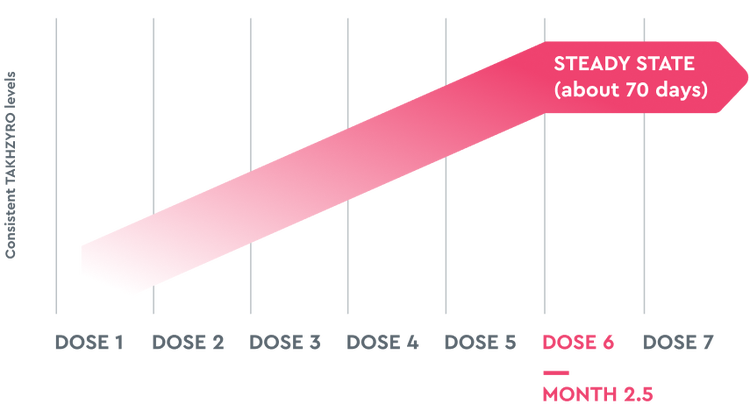
TAKHZYRO has a half-life of ~14 days and dosing is every 2 weeks. Because of this, it takes ~10 weeks (ie, 6 doses) to reach steady state and ~2 weeks until 50% of TAKHZYRO is eliminated from the body.2,3 This provides patients with freedom from daily dosing.
Patients who remain on TAKHZYRO
- Since 2018, 82% of patients remained on TAKHZYRO for at least 1 year (N=4131)4
- 91% of patients on TAKHZYRO for at least 1 year continued for at least a second year (N=2970)4
- 85% of patients on TAKHZYRO for at least 2 years continued for at least a third year (N=2535)4
Based on third-party US specialty pharmacy data and internal persistence data collected as of January 2025.
Challenge your patient to make a commitment to themselves and TAKHZYRO
Take each dose as prescribed
TAKHZYRO continues to work as it is taken, so it is important to tell your patients to take each dose as prescribed. Remember to impress upon them to avoid skipping or missing doses.2
Breakthrough attacks
It is normal for patients to experience breakthrough attacks.2
It is recommended that patients keep their acute medication on hand in case of a breakthrough attack.1
Let your patient know that if a breakthrough attack happens, they should not be discouraged. They should keep taking TAKHZYRO as prescribed and discuss their experience with you.
Stay the course
Over time, your patient may begin to notice that their attacks are less severe or that they are using their on-demand treatment less. These are signs that TAKHZYRO is working.
Help patients stay prepared to prevent HAE attacks
Encourage your patients to keep taking TAKHZYRO exactly as you prescribed. Although some patients may start to see results quickly, due to a half-life of ~14 days, it takes ~10 weeks (ie, 6 doses) to reach steady state.2,3 Suggest these tips to help your patient initiate a routine and remember their dosing schedule:
- Get alerts or reminders:
- Create a calendar event on their phone or computer with a notification alert that repeats every other week
- Sign up for the TAKHZYRO Text Reminder Program. They will get a text message the day before and the day of their scheduled dose. Tell them to visit TAKHZYRO.com or text SIGNUP (o RECORDAR en español) to 36395 to get started*
- Ask their loved ones for help. Ask a family member or friend to remind them when it’s time to take their TAKHZYRO
- Choose a dosing day that works best for their lifestyle. Think of something that will be easy to remember. For example, they could try "TAKHZYRO Tuesday"
*Message and data rates may apply. Average of 3 messages per month. Text HELP to 36395 for more information or text STOP to 36395 to end text reminders. View our Terms & Conditions at engagedrx.com/tak
Following up with your patients
- Continue check-ins with patients, even after ≥6 months of TAKHZYRO
- TAKHZYRO can be dosed less often if a patient is attack free for >6 months1
- Remind patients about the impact prevention with TAKHZYRO has had
- Ask patients how frequently they experience attacks
- Also ask if the severity of attacks has changed and how long they've gone without an attack while on TAKHZYRO
Long-term prevention. Long-term support.
Helping your patients stay on track with treatment
Whether you currently treat patients with HAE or have prescribed TAKHZYRO recently, it’s important to help you and your patients plan for the long term.
In addition to the established safety profile and clinically proven efficacy of TAKHZYRO, evaluated across 2 studies of adult and adolescent patients ≥12 years of age,2 Takeda has:

in treating and providing access and product support for patients with HAE
With more than 4500 patients prescribed,* including 130+ pediatric patients as young as 2 years of age since 2023, TAKHZYRO may be an option for your patients and their family members with HAE.2,4
*Based on third-party US specialty pharmacy data.
Starting off right with TAKHZYRO
Establishing treatment expectations and goals

- HAE is a genetic, unpredictable, and lifelong condition, and it's important to set specific goals for therapy5
- Choosing effective prevention with TAKHZYRO means working together with your patients to help prevent and reduce the severity of their HAE attacks, which may align with their treatment goals1,2
Create a regular check-in schedule to review progress and treatment goals—as routine monitoring is recommended by the 2020 US HAEA guidelines.1
Ready to start your patients on TAKHZYRO?
References: 1. Busse PJ, Christiansen SC, Riedl MA, et al. J Allergy Clin Immunol Pract. 2021;9(1):132-150.e3. doi:10.1016/j.jaip.2020.08.046 2. Takhzyro. Prescribing information. Dyax Corp; 2025. 3. Wang Y, Marier JF, Kassir N, Chang C, Martin P. Clin Transl Sci. 2020:13(6):1208-1216. doi: 10.1111/cts.12806 4. Data on file. Takeda Pharmaceuticals. 5. Maurer M, Magerl M, Betschel S, et al. Allergy. 2022;77(7):1961-1990. doi:10.1111/all.15214